 Angelica Rhoda
Travel
flight vs cruise to Cape Town carbon footprint
flight vs cruise to Cape Town carbon footprint
You want the carbon cost of getting here. Plain answer first: flight vs cruise to Cape Town carbon footprint shows flying usually has the lower CO2 per passenger. Our trip carbon estimator models the whole route, cabin class and ship type. For example, it gives a London return in economy of about 3.1 tonnes CO2e per person and a full ocean voyage on a typical liner near 12 tonnes CO2e per person for the same origin and dates. Run your exact route in the estimator for a personalised figure.

[PHOTO]
Cape Town International Airport
[PHOTO]

Where: Cape Town International Airport, Matroosfontein. Why we mention it: for many long-haul trips, a flight arrives faster and with lower door-to-door CO2 than a full ocean crossing. Faster travel also means fewer nights away from home and less local transport. Flight schedules and new seat classes can change seasonally; see route news on Travel News for recent updates.
Tip: arrive car-light. Take the MyCiTi airport service or a scheduled shuttle into the city and book a first night near an easy public transport stop. Check our live map for bus stops and bike hire near your accommodation.
V&A Waterfront (cruise berth)
[PHOTO]
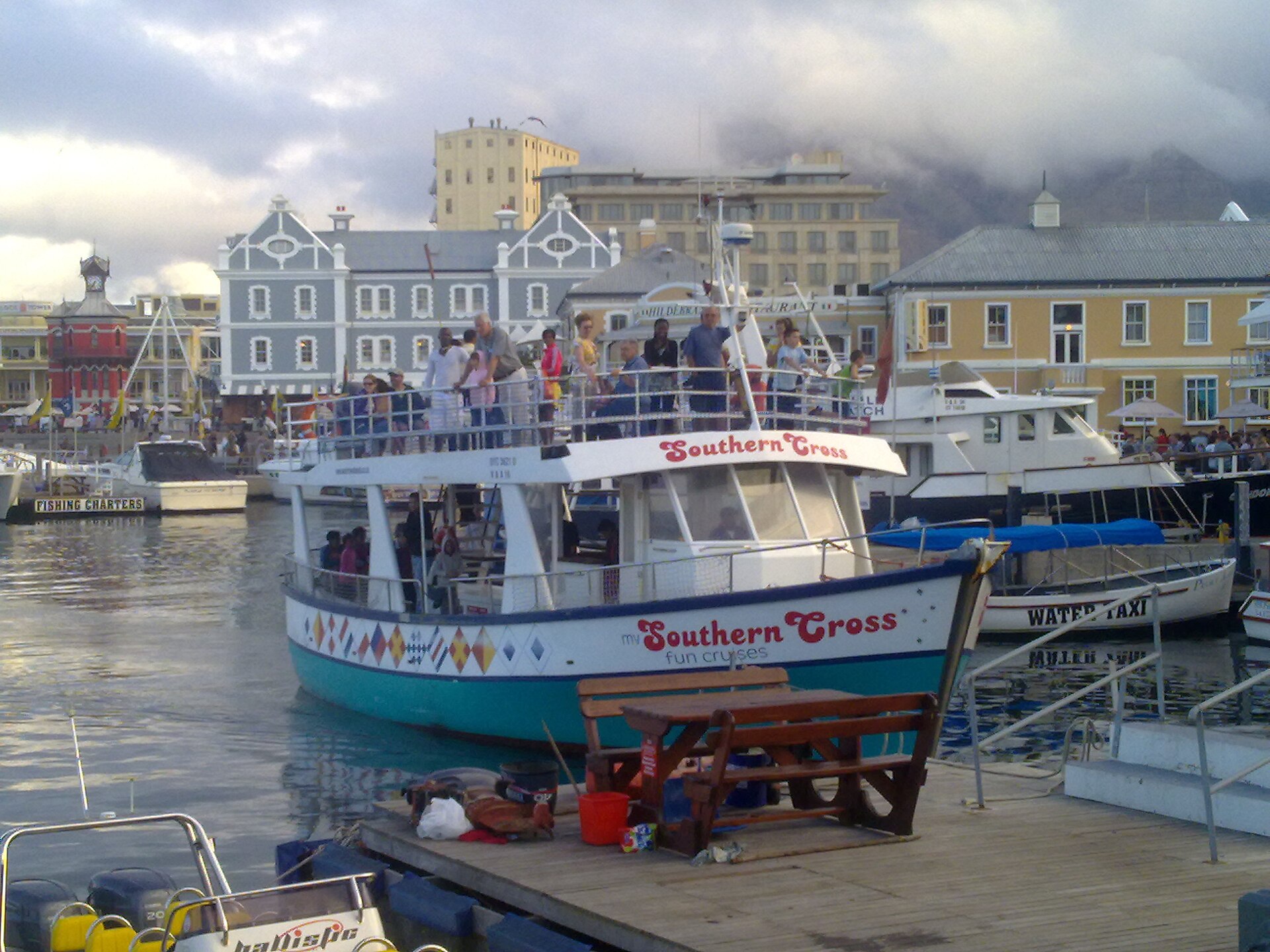
Where: cruise ships berth at the V&A Waterfront. Why we mention it: arriving by sea is a different rhythm. You step off a ship and Table Mountain is often the first thing you see. The trade-off is time and emissions: cruises take longer and, per passenger, tend to emit more CO2 for the same origin than flying. Cape Town Tourism keeps passenger and berth details current; check their practical notes at Cape Town Tourism.
Tip: if you choose a cruise, arrange transfers before you land and look for public shuttles or scheduled services into the city to keep your time ashore low-impact.
Cost and time trade-offs: flights are the fastest option. Cruises are slower and usually higher in CO2 per passenger for comparable long-haul origins. Mixed fly+cruise itineraries sit between the two, the sea-leg length and the ship's fuel type matter a lot. Our estimator is the only place on this site that combines cabin class and ship type in one calculation, so use it to compare like for like.
Our pick: if reducing CO2 is your priority, fly economy and arrive car-light. If the voyage itself is the reason you travel and you accept higher emissions, pick the ship and then plan public or shared transfers on arrival so your time ashore stays lower-impact.
Next steps
- Run your route in our trip carbon estimator for exact CO2 numbers by origin, cabin and ship choice.
- Book a MyCiTi Airport bus or a scheduled shuttle from the V&A Waterfront and check our live map for stops and bike hire near your first night.
- Follow our Cape Town in 5 days, car-free plan to keep your arrival and first days low-impact.
Now you have the numbers and the choices. Pick the route that matches your time, budget and how much sea you want.
Questions travellers ask
Does a cruise always emit more CO2 than a flight?
Not always, but for many long-haul origins a full ocean voyage emits more CO2 per passenger than flying. Use our <a href="/tools/trip-carbon/">trip carbon estimator</a> to compare your exact itinerary and cabin or ship type.
Can I lower emissions if I sail rather than fly?
You can reduce shore transfers and choose greener local transport, but the ship leg is usually the biggest source of emissions. If emissions are your priority, flying economy is typically lower.
Where can I find official cruise arrival info for Cape Town?
Cape Town Tourism keeps passenger and berth information up to date at <a href="https://www.capetown.travel/all-aboard-cruises-to-and-from-cape-town/">capetown.travel</a>.
How do I plan a car-light arrival from the airport?
Take the MyCiTi airport bus or a scheduled shuttle into the city. Check our <a href="/map/">live map</a> for routes and pick a first night close to public transport links.